
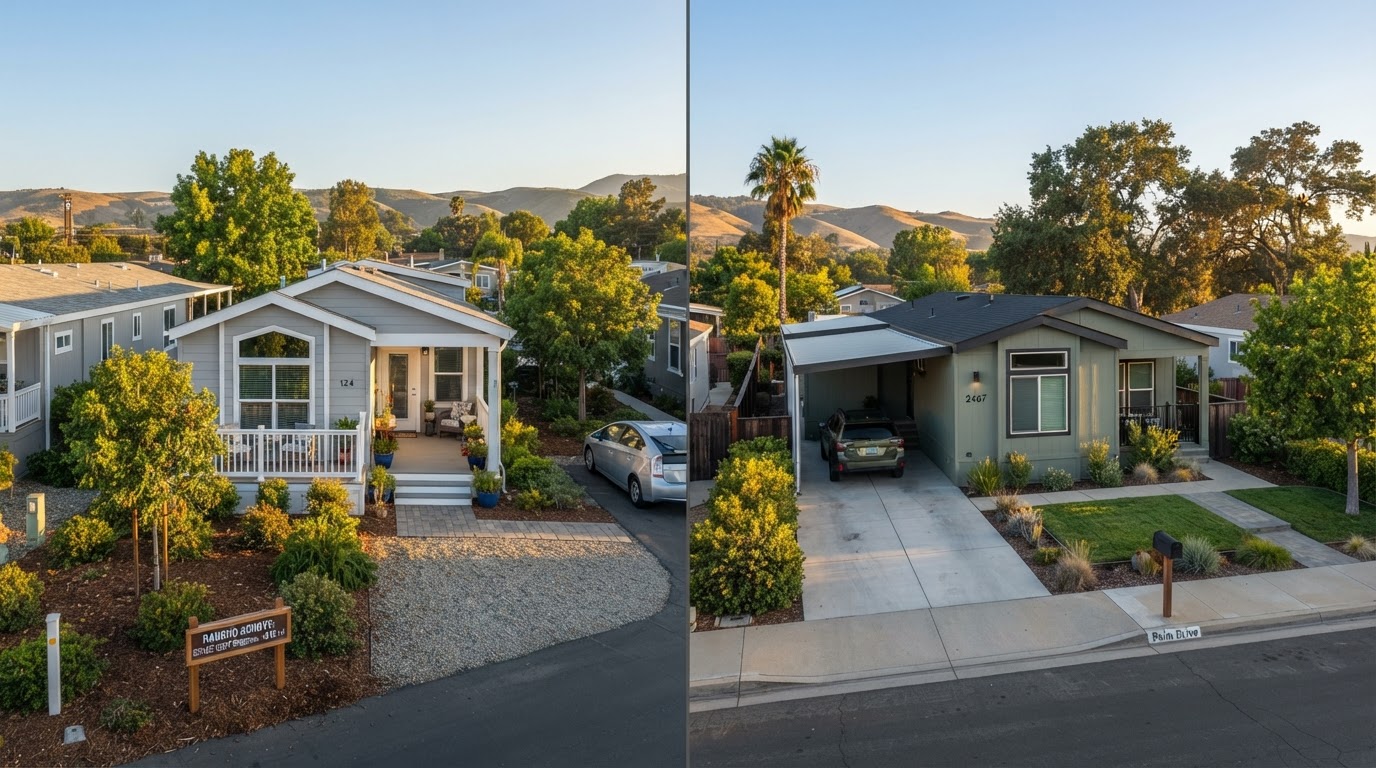
Land-Lease vs. Land-Owned: How to Choose the Right Manufactured Home in California
The single decision that shapes your price, financing, monthly cost, and resale is whether you buy the home or the land under it. Here is a clear comparison of land-lease and land-owned manufactured homes — and which path fits which buyer.
Before you compare floor plans, parks, or prices, there is one decision that quietly shapes everything else about buying a manufactured home in California: do you own the land underneath it, or do you lease it?
It sounds like a small distinction. It is not. That single choice changes your purchase price, your financing options, your monthly carrying cost, your tax treatment, and how the home holds value over time. Get it right and the rest of the purchase falls into place. Get it wrong and you can end up with a home you love in a structure that works against you.
Here is a clear, side-by-side breakdown of land-lease and land-owned manufactured homes — and how to tell which path fits your situation.
The One Decision That Shapes Everything Else
A manufactured home is the structure. The land is what it sits on. In California, those two things can be owned together or owned separately — and that is the whole ballgame.
In a land-lease arrangement, you own the home itself but rent the lot it sits on inside a manufactured home park or community. You pay a monthly space rent to the park for the right to keep your home there.
In a land-owned arrangement, you own both the home and the lot it sits on. The home has typically been converted to real property (often through a process documented on a California HCD Form 433A), which means it is financed, taxed, and sold like any other piece of real estate.
Almost every other difference between the two — price, financing, monthly cost, resale — flows from that one distinction.
Land-Lease 101: What You Own and What You Pay For
Land-lease is the more common path in California's manufactured home market, especially in 55+ communities and established parks. Here is what it actually looks like:
- What you own: The manufactured home itself, titled as personal property (chattel) unless it has been affixed and converted.
- What you pay: A monthly space rent to the park, plus your own utilities, insurance, and any park amenities fees.
- How you finance it: Typically with a chattel loan — a personal-property loan — rather than a conventional mortgage. Chattel rates run higher than mortgage rates, terms are shorter, and the lender pool is smaller.
- Park approval: You must be approved by the park to live there. The park reviews credit, income, and background before granting residency. That approval is a condition of the sale.
- Entry price: Lower. Because you are not buying land, the purchase price of the home is typically a fraction of a comparable land-owned property.
The trade-off is simple: a lower purchase price in exchange for an ongoing monthly space rent and a financing structure that is more rate-sensitive than a conventional mortgage.
Land-Owned 101: Real Property, Real Mortgage
Land-owned manufactured homes sit on a lot you own. When properly affixed and converted, the home is treated as real property — which unlocks the tools of the conventional real estate market.
- What you own: Both the home and the land beneath it, deeded together as real property.
- What you pay: Property taxes on the combined value, and any HOA dues if the home is in a planned community. No space rent.
- How you finance it: Conventional, FHA, and VA loans are all available when the home meets real-property standards (permanent foundation, 433A recorded, and similar requirements). That means lower rates and longer terms than chattel financing.
- No park approval: Because you own the land, there is no park management to approve your residency. You control the property.
- Entry price: Higher. You are buying land as well as a home, so the total cost is greater — but you carry no monthly space rent.
In short: a higher upfront cost in exchange for conventional financing, no space rent, and full ownership of the dirt under your home.
The Total Monthly Cost Comparison Most Buyers Get Wrong
Here is where buyers make the most common mistake. They compare the purchase price of a land-lease home to a land-owned home and conclude the land-lease is "cheaper." Sometimes it is. Sometimes it is not. The purchase price is only the down payment on your monthly cost.
For a land-lease home, your monthly cost is: chattel loan payment + space rent + utilities + park fees. Space rent in many California parks runs from several hundred to well over a thousand dollars a month, and it is subject to scheduled increases.
For a land-owned home, your monthly cost is: mortgage payment (often at a lower conventional rate) + property taxes + insurance + any HOA dues. There is no space rent line item, but property taxes on owned land are real.
The honest comparison is total monthly carrying cost, not sticker price. A $120,000 land-lease home with $900 in monthly space rent and a higher-rate chattel loan can carry a monthly cost similar to a $280,000 land-owned home financed conventionally. Run both numbers before you decide — and assume space rent will rise over your holding period, because in California it usually does.
Resale and Appreciation: How Each Holds Value
The two structures also behave differently when you sell.
Land-owned homes generally appreciate more like traditional real estate, because the land itself holds and gains value. They are also easier to finance for the next buyer, which broadens your buyer pool at resale.
Land-lease homes tend to appreciate more slowly, because the structure depreciates while the land — which you do not own — is what would otherwise drive appreciation. The resale value of a land-lease home is heavily influenced by the park's space rent, rules, and reputation. A well-run park with stable, reasonable space rent supports resale value; a park with aggressive rent increases suppresses it.
This is not a reason to avoid land-lease. It is a reason to evaluate the park as carefully as you evaluate the home. In a land-lease purchase, you are buying into a community as much as a property.
Which Buyer Fits Which Path
Neither path is universally better. Each one fits a different buyer profile:
- First-time buyers on a budget often fit land-lease. The lower entry price and smaller down payment make ownership achievable sooner, and many 55+ communities offer amenities and community that buyers value more than land ownership.
- Retirees seeking community frequently choose land-lease in age-restricted parks, trading land ownership for shared amenities, social structure, and lower upfront cost.
- Buyers who want conventional financing are better served by land-owned, because FHA, VA, and conventional loans are available and rates are lower than chattel financing.
- Cash and large-down-payment buyers have an edge in both paths, but especially in land-lease — where the financed buyer pool is thinner and more rate-sensitive, as we covered in our piece on cash buyers in a rising-rate environment. A cash offer can also sidestep chattel financing hurdles entirely.
- Investors and long-term holders typically prefer land-owned for appreciation and financing flexibility, though land-lease can work for cash-flow strategies when space rent is stable.
The right answer depends on your budget, your timeline, your financing, and how much you value owning the dirt versus being part of a community.
Rory's Take
I have helped California buyers through both paths for over 25 years, and the buyers who get burned are almost never the ones who picked the "wrong" path. They are the ones who did not realize they were picking a path at all — who bought a land-lease home expecting it to behave like land-owned, or who took on a chattel loan without budgeting for rising space rent.
Both land-lease and land-owned can be excellent choices when you go in with your eyes open. Land-lease gives you an affordable entry into ownership and, often, a genuine community. Land-owned gives you real property, better financing, and long-term appreciation. The mistake is assuming the lower sticker price is always the better deal — it is not, once you add up space rent, chattel rates, and resale behavior.
At CoMoHo, we help you run both numbers honestly, evaluate the park if you are considering land-lease, and coordinate financing, park approval, and 433A conversion if you are considering land-owned. Download our California Buyer Guide, browse current manufactured home listings, or reach out to our team to talk through which path fits you. The right decision is the one made on purpose.
Have Questions About This Topic?
Rory the Broker is here to provide straight answers and expert guidance for your manufactured home journey.